
Cable Route
Thermal Survey
Through our experience and expertise, using the state-of-the-art test equipment
A thermal survey of the proposed cable route is essential to evaluate the thermal and geotechnical properties of the subsurface or sub bottom soils.
This includes the measurement of ambient temperature and in-situ thermal resistivity at select locations and depths. Industry standard soil boring/sampling procedures are followed in accordance with the ASTM. This is the first step in a cable system design from Ampacity (cable rating) viewpoint.
Through our experience and expertise, using the state-of-the-art test equipment (Thermal Property Analyzer-TPATM) and accessories (custom-built thermal probes) we provide these services for underground as well as submarine power cable routes.
Offshore (Marine) Surveys
Are performed using a barge or a boat, utilizing a vibracore or a conventional soil drill rig. Our thermal probe is attached to a standard drill rod and pushed into the seabed/sediment where measurements of ambient temperature and thermal resistivity are made at various depths down to the proposed cable burial depth.
Onshore (Land) Surveys
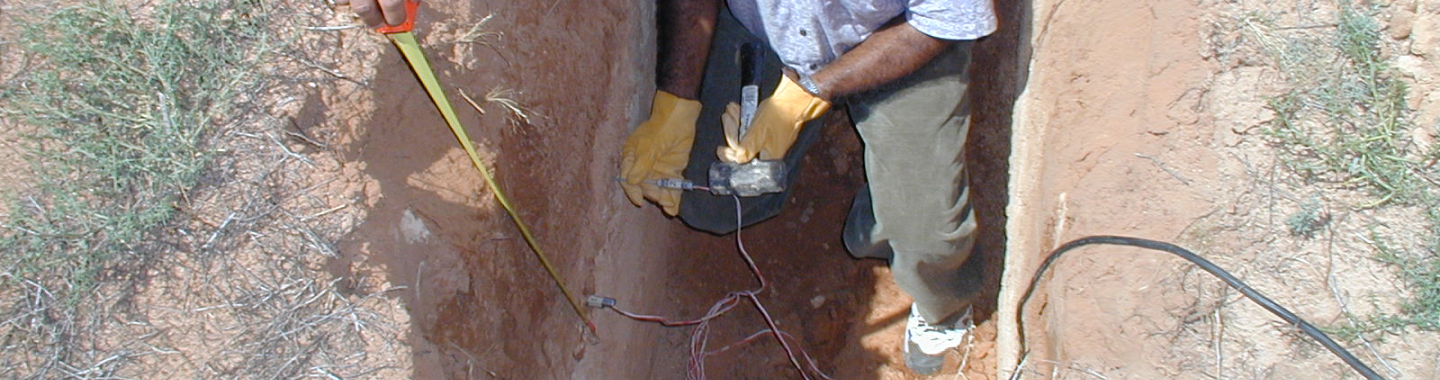
an be conducted using conventional drill rig for measurements to deep depths, or a backhoe for shallow depths of up to 5-ft (1.5m).
- Drill rigs are used when the cable burial depth exceeds 5-ft or when a backhoe cannot be used, such as city streets or highly congested areas with existing underground services.
- A backhoe is typically used for projects where a test pit can be excavated to perform measurement of ambient soil temperature and thermal resistivity and sample collection. This is the most common and cost-effective approach on renewable energy (wind, solar), BESS and data center projects.
- In-situ measurements are conducted at several depths to cover the proposed cable or duct-bank burial depths.